Neocon points on high crimes and misdemeanors

I. The first several paragraphs of this lengthy disquisition, providing some etymology and colonial American background on high crimes and misdemeanors, argue that the Founders left the phrase grave but broad intentionally. The phrase was intended to be a real check on the powers of the Executive, without being so elastic as to give Congress a parliamentary ability to remove a president at any time for narrow political motives. This general characterization is valid as far as it goes.


Note, however, that this article, written with William J. Clinton in mind, emphasizes offenses besides treason or bribery, since the GOP Congress was not accusing him of those. George W. Bush may not be limited to the purview of the high crimes and misdemeanors phrase. Taking the least of the offenses first

Today

Here, young readers, are the first few grafs of a Washington Post article that ran on December 2, 2003. Gov. Howard Dean of Vermont was making rapid headway toward the Democratic presidential nomination:


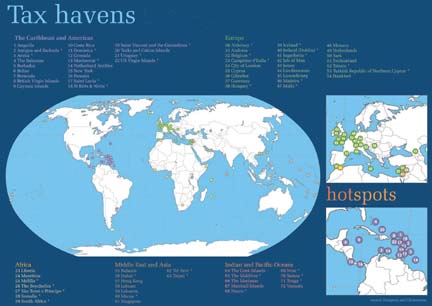
Offshore Tax Havens

Offshore tax havens

Map of tax haven hot spots

The gutsy Senate investigation into offshore tax havens has produced explosive material. Too bad there wasn’t more of an explosion in the big media outlets. On August 1, the Permanent Subcommittee on Investigations released its 370-page report with an equally thick stack of primary documents, in conjunction with a five-hour hearing and often dramatic testimony recorded by four or five television cameras. CNN chose that day to spend its air time on Fidel’s “ceding power,” running repetitive footage of sweaty Miamians honking their automobile horns and saying deleterious things about Castro.

Wonder which network offshores its assets in the Caymans.

Cayman Islands beach

Because someone has to do so, this blog recaps some of the pertinent numbers (page numbers in parentheses):

  • The Subcommittee report begins, “Offshore tax havens and secrecy jurisdictions today harbor trillions of dollars in assets.” (1)
  • “Experts estimate that Americans now have more than $1 trillion in assets offshore and illegally evade between $40 and $70 billion in U.S. taxes each year through the use of offshore tax schemes.” (1)
  • “In 2000, Enron Corporation established over 441 offshore entities in the Cayman Islands.” (2)
  • “A 2004 report found that U.S. multinational corporations are increasingly attributing their profits to offshore jurisdictions, allocating $150 billion in 2002 profits to 18 offshore jurisdictions, for example, up from $88 billion just three years earlier.” (2)
  • “The British Virgin Islands is a group of islands in the Caribbean and an overseas territory of the United Kingdom. It has licensed 11 banks, 90 trust companies, and 90 registered agents. The British Virgin Islands has over 500,000 registered offshore corporations, apparently the most of any offshore jurisdiction.” (15)
  • “The Isle of Man . . . is home to 171 offshore service providers, including banks, trust companies, and company formation agents. Together these firms managed about $57 billion in bank deposits, $12 billion in collective investment schemes, $33 billion in life insurance funds, and $11 billion in non-life insurance funds.” (15)
  • “In early 1990, John Staddon, Chris Donegan, and Rajan Puri moved from UBS to European American Investment Group (“Euram”). Euram is a financial services provider with offices in six cities, including New York, London, and Vienna. It was founded in 1999 by professionals from UBS, Deutsche Bank, and McKinsey. Euram employs ninety full-time staff working in areas including securities brokerage, investment advising, and wealth management.” (61)
  • “The paper portfolio was “created” by having two Isle of Man companies with no apparent assets exchange contracts with each other. Under these contracts, Jackstones, which owned no stock, would “sell” stock to Barnville in exchange for cash that Barnville did not have, and Barnville would “loan” the stock, which it had not received, back to Jackstones in exchange for the payment of cash collateral, which Jackstones did not have. Because these transactions were undertaken simultaneously, the two obligations to pay each other equal amounts of cash and stock would be offset. No stock ever changed hands, and no money ever changed hands.” (63)
  • ‘The records show that Barnville was incorporated . . . with one share of stock each subscribed to by Paul Moore on behalf of Claycroft Limited and Paul Moore on behalf of Dalecroft Limited. Annual returns . . . show that . . . its authorized capital was 2,000 British pounds (of which 2 pounds had been paid in).” (69)
  • “As of September 24, 2001, HSBC estimated that its total fees on the transaction would be $8,890,000.” (104)
  • “Quellos’ total compensation for the Saban POINT trade was $53,909,930 . . .” (112)
  • “The following case history shows how, over a thirteen-year period from 1992 to 2005, two U.S. citizens, Sam and Charles Wyly, guided by an armada of attorneys, brokers, and other professionals, transferred at least $190 million in stock options and warrants to a complex array of 58 offshore trusts and shell corporations.” (113)
  • “Section six shows how about $85 million in untaxed dollars were used to acquire U.S. real estate and build houses for use by Wyly family members. It also shows how untaxed dollars were used to finance real estate loans that supplied millions of offshore dollars to Wyly family members for their personal use in the United States.” (118)
  • “In provisions that became effective in 2002, the Patriot Act explicitly required U.S. banks and securities firms that open a private account with at least $1 million for a non-U.S. person to “ascertain the identity of the nominal and beneficial owners” of the accounts.” (118)

An eye-opener, all around, and a window onto the cowardly maneuvers employed by people who don’t need the money in the first place to deny tax dollars that pay for–among other things–federal courts, where their high-priced legal help can argue before judges that they shouldn’t have to pay those taxes.

Cayman courts find hedge funds

Hedge fund regulation and the Senate Banking Committee

It is sad to reflect that if slavery were by some hideous quirk made legal again, undoubtedly a certain number of individuals in the U.S. would be willing to sell themselves into it. This morning, the Senate Banking Committee held a hearing on regulating what in the world of finance is known as hedge funds.

To start with, there is more than one definition of hedge funds. Broadly, however, they are gigantically capitalized entities for high-risk investment. They are in some ways the riskiest form of investment, and they don’t deal in small amounts of money. And as Sen. Richard Shelby, head of the Banking Committee, and Christopher Cox, head of the SEC, both stated, hedge fund growth in this country (which, with Great Britain, is home to most hedge funds) has been enormous and startling over the past few years. Cox testified that the amount of capital under management in hedge funds has grown to approximately $1.2 TRILLION. Cox also stated that hedge funds account for “about 30% of all U.S. equity trading volume.”

Shelby pointed out that “wealthy investors and large institutions” attracted by hedge funds include “pension funds and universities.” There is room for concern here, especially since a U.S. Appeals Court recently struck down some federal attempts to bring hedge funds somewhat more under SEC regulation.

Sen. Paul Sarbanes (D-Maryland), excellent and lucid as usual, raised three concerns: 1) whether the standards for an “accredited investor” (currently anyone with over a million, including your house) are too low; 2) potential conflicts of interest in managers of hedge funds and mutual funds; and 3) the impact on financial markets of hedge fund strategies on a large scale, including short-selling.

Sarbanes also brought up a concern voiced by the AFL-CIO, about worker pension funds. There seems to be a move currently to allow more pension funds in hedge funds, a scary prospect for millions of workers counting on pensions to support them in retirement.

Sarbanes also asked about what might happen in a market shock — a “run on the bank,” in which large numbers of hedge fund investors withdrew from their hedge fund at the same time. Basically, to the question, “what would you do?” the answer was — something along the lines of, we’re looking at that.

Three witnesses appeared before the Committee — the head of the SEC; the head of the U.S. Commodity Futures Trading Commission, Reuben Jeffery III; and the head of — No, not the head of Treasury but an undersecretary in Treasury named Randal K. Quarles. Quarles’ answers were not reassuring.

Nobody mentioned that one sizeable hedge fund is operated by the president’s youngest brother, Marvin P. Bush. But then, nobody needed to mention it.

Quarles, BTW, is one of the new breed of Bush appointees, much like an undersecretary from State, John Hillen, whom I heard “testify” to Congress last week, on the administration’s support for a new sale of F-16s to Pakistan. Yes, that’s right, little friends. Just at the juncture when the Pakistanis are bringing out new developments along the nuclear line, the White House wants them to get more F-16s. Hillen and Quarles struck this viewer much as less senior, white male versions of Condoleezza Rice, except perhaps a tad less philosophical and independent — future First Family employees, basically.

Back to the top: one question is why the federal government, or some of the most august names on Wall Street, should be aggrandizing hedge funds in the first place. Just because some people want high-risk opportunities, does that mean the rest of us have to provide them — and pay to regulate them, and provide the courts in which they try to avoid regulation, and pay Congress to try to control them?

You’d think that people so eager for a good risk would be particularly able to stomach NOT getting what they want. Shd be a real shot in the arm, one would think.

I read years ago that a “risk” is one thing; a “gamble” another. But it seems to be BushCo’s broad strategy to maximize gambling rather than genuine risk. Perhaps that’s just another way of saying that they tend to privatize gain (for the few) while socializing penalty/payment (for the overwhelming majority).

More timely as time passes: Andrew Thomas’s Aviation Insecurity

Almost five years after September 11, 2001, the book titled Aviation Insecurity, by security analyst Andrew Thomas, published by Prometheus Books in 2003, is only becoming more timely.


Some books do not wear well over time, but this one does. Virtually every passing month further corroborates the discussion and analysis by Thomas of U.S. lack of aviation security before September 11 and now.


Reading successive chapters about the culture of compromise at the FAA, the actions of the White House and Congress to bail out the airlines immediately after September 11, and the creation of new layers of bureaucracy under the guise of security is like watching time lapse photography in motion. Especially now, while we watch the Middle East go up in flames and even commentators chastise the president for  supposedly not knowing it would happen, we see with the clarity of hindsight how thoroughly the airlines influenced governmental processes that were supposed to work for the public interest. The result is that our federal agencies, in spite of the courageous work of many lower personnel, are tainted and compromised by the aviation industry they were supposed to monitor and regulate. As one commentator said succinctly,

Condoleezza Rice slips, makes unintentionally true statement

This morning on This Week with George Stephanopoulos (ABC), Condoleezza Rice, interviewed on the violence in the Middle East:

Rice, awkwardly trying to justify the administration’s non-support of a cease-fire, stays with the Bush-Cheney fantasy line that “extremists” facing “a new Middle East” are the cause and source of the violence. (No mention of repressive regimes or the mistreatment of Palestine.)

Her reasoning is the neocon argument that past peace-keeping efforts in the past didn’t “work” –i.e. since no peace lasted forever, lives saved or quality of life improved in the interim don’t matter a whiff.

No time for obvious fallacies right now; this blog just to highlight a statement worthy of thought: Rice, winding up her peroration, asks rhetorically, “Where do we think Hezbollah and Hamas [etc] came from?”

Bingo. Those “extremists” — and this is the point that Bush-Cheney ALWAYS mask — are people, and they come from populations. Populations revolt when life becomes untenable. 

BTW, it is beside the point to accuse Bush-Cheney of being the “extremists,” and false to call them “radical” — a term meaning etymologically rooted, to the root, fundamental. That’s the last thing they are. They’re a cabal. This is the geopolitics of corruption and cabal at work, aggrandizing violence by every feasible means (not too overt) and at every level.

Re that last point: 1) Bill Kristol calls for war with Iran in today’s Weekly Standard, the paid-propaganda organ of the neocons; Fareed Zakharia made a good point dismissing the editorial, and even George F. Will demurred. 2) Weapons used in some horrific shootings in D.C. last week were brought back from Iraq and sold here at home. There will be more of that, to be sure, if this administration has its way.

Right now the president and Mrs. Bush are traveling around the country trying to sound nice. But there is only too much reason to fear that when fall 2006 elections are safely past, the administration will manage to achieve the major it wants against Iran, either directly or through Israel.

Meanwhile, the untruthful Condoleezza Rice, Laura Bush and Lynne Cheney have helped to bring about the deaths of thousands of little girls in Iraq. They support a foreign policy that is itself war crime — the immoral, illegal and unconstitutional invasion and occupation of another country.

Miraculous timing of the skyjackers, Part 3 – getting the right seats on 4 planes

Aside from other factors, one that surely worked to the advantage of the 9/11 hijackers was that each of the four flights they caught on that fateful day was carrying significantly less than a full passenger load. Again we have what appears to be little short of a miraculous concatenation of timing and other circumstances:


Since the four planes, like the World Trade Center, were mercifully not full to capacity, casualties ultimately proved less than they might otherwise have. On the other hand, the hijackers also had fewer passengers to overpower or keep under control, and there was less passenger weight to use up fuel. Magically, the flight that carried four hijackers rather than five — United Airlines flight 93