
On May 4, 2006, the Attorney General opened up access to DOJ criminal investigations to Cheney

The excellently well-prepared Senator Sheldon Whitehouse (D-RI), probably one of the best senators in Congress, offered up a real eye-opener in today’s Senate Judiciary hearing. The hearing ostensibly dealt with politicization in the Department of Justice but provided little new regarding Gonzales.

Mean, harsh, repetitive and stupidly thuggy Sens Arlen “Bash Anita Hill” Specter (R-PA) and Chuck “check kiting” Schumer (“D”-NY) did their usual thing — 90% wasting time, 10% good points or what should have been, and 100% self-dispay — while as usual making me feel sorry for Gonzales.

Critics of the administration have good points to make, to put it mildly. They should act that way. Grandstanding and meanness make them sound as though they themselves do not actually what’s wrong about politicizing the Department of Justice. Congress had the option of reining in the administration back in 2001, 2002, 2003, 2004, 2005, and 2006. That it largely waited until GWBush was down in opinion polls with hospital waste does not speak well for its grasp of essentials. Hectoring someone like Alberto Gonzales, who clearly misplaced his trust in Bush and genuinely does not handle aggression well — like many of us — proves only that individuals like Specter and Schumer never should have been elected.

Whitehouse asked questions about two memorandums from two Attorneys General, Ashcroft and Gonzales, and provided print copies of the memos. The first, dated April 15, 2002, was signed by John Ashcroft. The second, dated May 4, 2006, was signed by Gonzales. Both enunciated the position, “It is imperative that there be public confidence that the laws of the United States are administered and enforced in an impartial manner,” and laid out procedures for communication between the Department of Justice and the White House.

The memorandum Gonzales signed on May 4, 2006 — and who knows who wrote it — drastically widened channels of communication, if you call them that, between DOJ and White House regarding criminal investigations and cases.

The Ashcroft memo allowed as-needed communications on criminal matters only “between the Office of the Deputy Attorney General and the Office of the Counsel to the President,” and on appellate matters only between president’s counsel and either the Deputy AG or the Solicitor General.

The May 4, 2006, memo opened the floodgates re info on criminal investigations. Communications were newly allowed between the DOJ and — not just president’s counsel, but the entire EOP (Executive Office of the President). And then there’s a footnote, as pointed out by Senator Whitehouse:

“As used in this memorandum, the term ‘EOP’ means the White House Office, the Office of Policy Development, the Executive Residence, the Office of Administration, the National Security Council staff, the Homeland Security Council staff, the Council of Economic Advisers, the Office of Management and Budget, the Office of National Drug Control Policy, the Office of Science and Technology Policy, the Office of the U.S. Trade Representative, the Council on Environmental Quality, the President’s Foreign Intelligence Advisory Board, and the Privacy and Civil Liberties Oversight Board. For convenience, the executive functions of the Vice Presidency are referred to in this document as the “office of the Vice President” or “OVP,”   AND THE PROVISIONS OF THIS MEMORANDUM THAT APPLY WITH RESPECT TO COMMUNICATIONS WITH THE EOP WILL APPLY IN PARALLEL FASHION TO COMMUNICATION WITH THE OVP.” [emphasis added]

In other words, from at least May 4, 2006, on — assuming this isn’t just a de jure ratification of something that had already been going on de facto for almost four years — the Office of the Vice President had access to presumably anything the Department of Justice knew about any criminal investigation. There is every reason to believe that the OVP had access to any continuing investigation into, for example, the Plame-CIA leak case.

It is not known whether the Office of Special Counsel Patrick Fitzgerald was given this information.

And yet we have the hideous rightwing noise machine brazenly arguing that the Special Counsel was going on some kind of fishing expedition. If anything, the CIA leak investigation was taking place in a giant goldfish bowl, where anyone liable to be affected by it probably knew almost everything that could happen — except for individual talent and conscientiousness on the part of prosecutors, jurors and judge in the matter.

More on that May 4 date later. For now, the work to do with Gonzales is not to keep dragging him in as a witness before the Specters and Schumers of Congress, bashing him as a substitute for doing anything effective for the American people. For a start, there is already more than enough evidence that the Judiciary Committee should unite across party lines to censure Bush and Cheney. Any decent Republican would do it in reaction to what Bush-Cheney have put Gonzales through.

As to the Democrats, they had ample help recognizing that the Bush White was “politicizing” agencies of government starting as early as 2001; I among other local writers noted it. New members of Congress were of course not able to do anything back then, but any claim by members like Schumer that he is somehow newly shocked by politicizing federal entities is bogus and should be treated as such.

Prolonging Vietnam, part 2: why was the Watergate bugged?

Prolonging Vietnam, part 2: why was the Watergate bugged?


The secrecy, manipulation and deceit of the Nixon years had no larger foci than the two consuming topics of Vietnam and the Kennedys, and for President Richard M. Nixon, those two topics were joined. The inescapable conclusion is that Watergate stemmed from them.


Nixon knew how unpopular the Vietnam War was, and against this backdrop of Vietnam as well as the larger backdrop of the Cold War, Nixon was secretly pursuing d

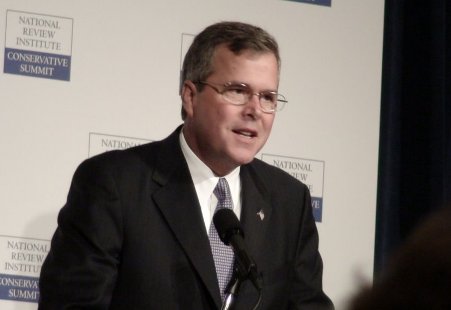
Iraq escalation benefits only Jeb Bush

Iraq escalation benefits only Jeb Bush

Senator McCain presents as someone who figures it’s his turn, per
generally the way GOP presidential nominations work—the next man in
line steps up, wins the nomination usually without too much difficulty,
and then wins or loses the general election. The occasional exception
like Barry Goldwater is characterized for a generation in party lore as
someone who tore the party apart and then went on to lose the
presidential election in a landslide. McCain is showing his loyalty in
spades to the Bush team, to the Oval Office. But only some obliviousness
to history would predict that his loyalty will be repaid with unstinting
support by Team Bush.

McCain

There can be no happy Iraq outcome for McCain. If things get worse–the overwhelming probability–then even he will be forced to bail on
the policy at some point, and the question will always be why he did not
do so earlier, saving more lives; why he did not put his independent
power base to better use. He will be associated with, and he is
aggressively associating himself with, catastrophe. If things were by
some miracle to get better, the Iraq War is still Bush’s war. Meanwhile,
Governor Jeb Bush sits comfortably by in Florida, in relative political
safety in spite of Mark Foley, the sugar growers, his family’s several
run-ins with the law, the ecological disaster in the Everglades, and the
ongoing election fraud in Florida. Jeb Bush is not tied to Iraq policy;
he has no son in Iraq; he is not storming the country in support of
Bush’s escalation.

Jeb Bush

White House Iraq policy at this point, in other words, may be guided by
desire to help Jeb win next time. This is the only perspective from
which the escalation makes even bad sense.

Of course, a plausible alternative explanation is that it makes no sense
at all—that it is merely Bush’s vain effort to prolong the war, which
is what he cares about most, while his cronies with both hands in the
cookie jar frantically extract their utmost.

Iraq escalation benefits only Jeb Bush

Iraq escalation benefits Jeb Bush


It is difficult to imagine the sane person who could imagine that supporting the Bush escalation in Iraq will benefit John McCain politically. Even the cleaned-up language in which the president dressed his presentation last night (January 10, 2007) makes clear that he expects further carnage. Chilling, and chillingly offhand, suggestions that the troops have had “too many restrictions,” that armed forces will have the “green light to enter” neighborhoods, and that they will be “going door to door

What prolonged the Vietnam War?

What prolonged the Vietnam War?

Nixon with Kissinger

Diaries of Nixon’s White House Chief of Staff, H. R. Haldeman, demonstrate that Nixon was fully aware in election year 1972 that the Vietnam War was not popular. The White House turned a paranoiac, watchful eye ever outward, constantly alert, scanning the political zodiac for any sign that the Democrats were going to capitalize on the unpopularity of the war.

Nixon came into the White House knowing he would not have won in 1968 had Robert F. Kennedy, his campaign rocket-propelled by opposition to the war as well as by the Kennedy mystique, not been assassinated; had Lyndon Johnson’s Vice President Hubert Humphrey not been inextricably tied to Vietnam; and had the early and effective opposition to the war by Eugene McCarthy not been derailed by RFK. The history of the Sixties is partly a series of flukes, had they not been tragic; a series of near-misses that narrowly avoided ending the Vietnam War on the larger scale and the political career of Richard M. Nixon among others on the smaller. At any moment the nation had the potential to rise up in organized, spontaneous political action to break the stranglehold of Vietnam.

RFK

Nixon knew it. Even the impossibly late entry into the 1968 nominating process of George McGovern, hero to the young, helped fuel the passion against Nixon and the war; even with opponents of the Vietnam War hopelessly split, there was such a Democratic reenergizing in the last few weeks and especially the last days of the 1968 campaign that Hubert Horatio Humphrey almost managed to squeak out a win. Citizens who had at long last turned away their scrutiny from LBJ and focused it on Nixon and Agnew got so motivated, or so steamed, that in some places HHH came into respectful treatment as a candidate that he scarcely received at the time he was nominated. At the start of his campaign, Humphrey could hardly get paid attention. At the end, there was such a surge that ordinary donors were literally throwing money–tens, small bills–at him or his people in personal appearances; his volunteers were opening hastily sealed envelopes of miscellaneous sizes and stationery, into which money had been thrust without request for receipt or sometimes even a note, sent via regular mail.

Unfortunately the Democratic Party of the time never did adequately focus on and oppose the Vietnam War, not in an adequately organized way, and historians are free to wonder why not. One cause was certainly the grief, fear and demoralization brought about by the assassinations of John Kennedy, Martin Luther King, Jr., and Robert Kennedy. (It is Orwellian that those murders, which did so much to wound and cripple the Democrats, have been vaguely blamed on some culture of Sixties permissiveness.) Another cause was the lack of a blocking agent, as John Stuart Mill would put it, in that the press was as usual royalist and timid in scrutinizing the actions of presidents in conducting war. (Regarding Vietnam, the press was additionally confused by a gullible view that Henry Kissinger would bring about peace if Nixon would let him.) Undoubtedly another cause was White House manipulation of internal Democratic Party politics, using tactics including bribery and assisted by several prominent personalities of the time including John Connally, Billy Graham and George Wallace.

But the war was always present, and opposition to the war was growing daily. One did not have to start from any particular spot on the political spectrum. When combat veterans started coming home from Vietnam by the thousands, if alive and relatively healthy they came home with a single, lucid, across-the-board recognition that many of them had acquired within a few minutes in Southeast Asia: “nobody [back home] knew anything.” The recognition did not necessarily translate into instantaneous and organized opposition, but it did translate into solid, bedrock, widespread lack of enthusiasm. That, in other words, was square one – not among draft resisters and war opponents but among people who had gone, and their relatives and acquaintance. Anecdotes about fragging First Lieutenants will do that.

Nixon knew it, and took steps accordingly.

Over the next few weeks, we in our time will be facing a chief executive bent more than Nixon was on prolonging and expanding a war. As always when there is heavy rightwing rhetoric on “moving forward,” we have to look backward to some extent for guidance on the tactics that will be used. Forewarned is forearmed.

The process might also shed some light, valuable for historians including amateur historians, on the question about Watergate often scanted even in good histories of Watergate. Why was the Democratic National Committee headquarters broken into in the first place?