
2004 Election revisited, part 5: DC games versus the grassroots

Dean
The presidential election cycle suffered an odd interlude in winter 2004. Few people remember now, and this kind of topic is not usually revived on cable or network talk shows, but what happened derailed or destroyed the most promising grassroots activity on the Democratic side.
Most politicos remember in some fashion the swift turn downward for Howard Dean’s campaign when CNN jumped on the so-called ‘Dean scream’ nonstop. Few to no politicos mention that the Dean campaign was also on the receiving end of attack by a particularly shadowy 527 organization.
This particular org seems to have been roused to action by some mention of health care in a campaign year. (Danger afoot; the public might like health.) A weird little one-or-two-man ‘group’ called “Americans for Jobs, Healthcare [sic], and Progressive Values” sprang suddenly into action, not to mention into existence.
Any investigation is, of course, history now. However, the trajectory of events looks to be uncomfortably relevant in election 2012, when those 527s are dwarfed by current super-PACs.
Midnight, February 2, 2004, was the deadline for filing IRS form 8872, the comprehensive financial disclosure required of political organizations called 527s. Form 8872 is another of those ‘regulations’ so hated by GOP presidential candidates. It is important because it reveals who has contributed money to the organizations, which, unlike individual candidates and political parties, do not have to file disclosure statements with the Federal Election Commission (FEC) but only with the Internal Revenue Service. Federal law requires that the forms be filed electronically, by any 527 organizations that took in or spent more than $50,000 in 2003.
Early the next morning, I checked the IRS web site to see the financial contributors for the elusive group called “Americans for Jobs, Healthcare [sic], and Progressive Values.” (Slight warning sign: politicians genuinely concerned about health care can usually spell it.)
The group officially began in November 2003, ran three anti-Howard Dean ads including an especially noxious one picturing Osama bin Laden, and almost immediately went inactive. Its web site went down or “under construction,” and it listed few contacts. Its second president in two months was insurance executive and former Ohio congressman Edward F. Feighan, but his insurance office in Columbus said that Feighan was no longer connected to “Americans for Jobs etc.” Feighan’s office could provide no current information about the group, its current officers, or whether it had a head. Spokesman Robert Gibbs, a former staffer of John Kerry’s in DC, did not return numerous calls and voice messages.*
There was no form 8872 or other quarterly filing for the group, and no filing beyond the initial form 8871 dated Nov. 14, 2003.
After more attempts, I was able to talk to the group’s treasurer, David W. Jones, a Democratic fundraiser in DC, who informed me that the organization was not dissolving but also stated that he was the group’s sole officer listed at this point. Jones referred me to Kenneth A. Gross, a partner in the large law firm Skadden, Arps, for information regarding Americans for Jobs’ financial filing.
Many attorneys do not even take Election Law in law school. Gross, in Bethesda, Md., has extensive credentials as an election law attorney and served in the FEC for six years under Reagan (1980-1986). Maryland public records show that Gross was a registered Republican but switched to the Democratic party in March 1993. “I’m a man of all trades,” he said affably. “I represent both Democrats and Republicans; I’m one of the few who do.”
Gross’s GOP credentials, however, were substantially more weighty, surprisingly for someone hired by Democrats. Gross’s resume:
- counsel for the 2004 GOP national convention.
- counsel for the Republican Leadership Council (RLC)
- the program for the RLC 2003-2004 Strategy Meeting featured Gross as a speaker on campaign finance reform
- counsel for Bob Dole’s campaign committee in 2000
- counsel for the Dole campaign in 1996, as he confirmed in his conversation with me.
Past candidates for whom Ken Gross had worked were either Republicans or, when Democrats, only in the Democrats in primary elections. All in all, an odd choice for any Democratic candidate, or at least for any candidate who wanted Democrats to win in November 2004. You’re running for office and have a hard-fought campaign in a tight election ahead. You hire Bob Dole’s legal counselor?
Ken Gross explained that Americans for Jobs etc had filed the required form with the IRS, the Friday before the deadline, but it had filed by fax, and the IRS did not immediately post the filing online. “It was filed,” he said. “The IRS failed to give us a [sort of] PIN number,” so the group could not file electronically. “They’re not very well equipped,” Gross commented. “It’s totally their fault. It’s not our fault at all.”
When all else fails, blame the IRS. So, Gross continued, “we worked it out with Ogden, Utah [an IRS office],” and sent it in by fax. “I guess they haven’t scanned it into the system yet.” When I asked to see the filing, or have it faxed to me, Gross turned me back over to Jones, who corroborated the filing by fax.
An IRS spokesman explained that 527s were required to file electronically, but if some glitch prevented their doing so in a timely manner, they could file by fax or on paper to show good faith. Electronic filing was still required when they received their PIN number. Form 8872 is required to disclose all financial information.
Tuesday, Feb. 3, 2004, was the day Democrats held primaries in seven states including South Carolina and Oklahoma. As of that date, Americans for Jobs, Healthcare etc still had a single filing online, its initial electronic filing dated Nov. 14, 2003, posted with its Employer Identification Number (EIN). On Tuesday, Jones offered to fax me the filing. I returned his call, leaving phone numbers and a fax number. No form arrived. Gross said that the filing was handled in his office, by Mark Ward. I called Ward on Wednesday to request a copy of the form, leaving my mailing address and a fax number with him. Ward explained nicely that he did not have a copy of the filing, and that he could not get into either the fax machine or the copier without a client number–“This is such a dumb thing to be held up by, you’ll think, what planet did I drop from”–but would try to see what he could do, and suggested that I call Jones again to request a copy.
Later that day I got a call from Melissa Miles, a SkadArps attorney representing Jones. She explained that “Dave knows he’s legally required to make a copy available” for viewing, within regular business hours, and recommended that I stop by Jones’ office, giving his address at Corporate Visions, Inc., on M Street. I said I could certainly stop by the next day, Thursday, Feb. 5.
Thursday morning I called Corporate Visions, where I happened to get a voice twin of Jones. When I asked whether I was speaking to Mr. Jones, however, the voice said “No, this is Corporate Visions.” Thursday afternoon, after repeated messages, Jones called me, saying that he had just gotten back from New York. When I offered to go to his office to see the filing, he offered instead to overnight it to me, saying at least twice that he had to show me “an original.” He assured me that he would UPS it to my home on Friday. The news that evening was full of a bad weather forecast for Friday, with possible icing; UPS headquarters confirmed that they do hold up deliveries in dangerous weather, but on Friday I received the filing.
The political calendar was loaded. Caucuses were held on Saturday, Feb. 6. Some large-state primaries were held on Tuesday, Feb. 10. On the phone, Jones offered to go over the form with me. He explained at length and repeatedly that the group had purchased three [anti-Dean] ads, totaling about $500,000. Of the total, the two ads referring to Dean’s gun and trade positions cost $485,000. Only $15,000, Jones emphasized, was spent on what he called the “foreign policy ad,” i.e. the one featuring Osama bin Laden. Jones reiterated that that one ad ran only sixteen times in South Carolina and New Hampshire, and never ran in Iowa.
Sounding somewhat harried, Jones also said that the Osama ad (“foreign policy”) got “hundreds and hundreds of thousands of dollars’ worth of free media attention,” with several major network news programs giving it national air play. As he remarked, that one ad, on which the group spent only $15K, got the most coverage, “national coverage for four or five straight days.” Jones: “You can blame your colleagues in the media for that.”
Numerous news reports linked the Osama ad to the Gephardt campaign. While the ad did not verbally compare Dean to bin Laden, visually it connected bin Laden’s face with Dean’s name, with a dark-aura image hard to shake off. By all accounts, the attack threw the Dean campaign off-message, away from his successful critique of Bush policies. Negative ads work.
Tthey also boomerang. The smarmy, dark, negative ad ended Gephardt’s candidacy. Jones, formerly a fundraiser for Gephardt among others, reiterated emphatically that the ads were not coordinated in any way with the Kerry campaign or with the Gephardt campaign, describing them as intended to make issues of Dean’s positions.
“His campaign is over.”
Jones took exception to my saying foreign policy experience as an issue usually benefits an incumbent president or vice president, or in the rare case of Richard Nixon, a former vice president. Most people do not connect governors or Congress with foreign policy, regardless of the campaign year. This is an advantage of presidential incumbency. In any case, there can be little doubt about the damage wrought by the Osama bin Laden ad: of the two previously strongest Democratic candidates for president, one (Gephardt) was out of the race, and the other (Dean) dropped behind.
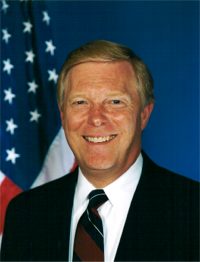
Gephardt
At that point, Howard Dean was still second to John Kerry in delegates won (121 to Kerry’s 260), and the race was still early. Dave Jones, however, vehemently and angrily insisted that Dean was “out”: “His campaign is over.”
Be it noted that Dean’s campaign had sidestepped professional fundraisers, getting its money through a successful Internet drive. This fundraising strategy employed by Dean, and by Ron Paul, was carried forward with even greater success by Obama in 2008 and is going forward for 2012 as well.
A more wide-open race generates more voter interest, by allowing voters more choice and more participation.** The best chance Democrats have to air issues of concern to the public is their primary season, in Democratic primaries and caucuses. Corporate media outlets are often less than eager to devote air time and print space to topics that they have failed embarrassingly to report.
Too bad they knocked Dean out.
Meanwhile, the filing belatedly reviewed showed that Americans for Jobs etc received $663,000 from 26 donors. The “Progressive Values” fell out of the basket. The donors had a strikingly not-progressive profile. Two-thirds of the donations were corporate, with two executives donating $100,000 each and another retired executive donating $50,000. Another $80,000 came from attorneys. The Torricelli for Senate Committee kicked in $50,000. Six labor unions donated $200,000; thus the laborers’ union and Loral corporation gave to the same folks. Expenditures, besides the half-million for television, included $40,000 to Jones’ firm, DWJ Consultants, and $15,000 to Skadden, Arps for legal expenses.
It would be odd if the highly experienced Kenneth Gross, with Americans etc from the beginning, did not foresee the dysfunctional impact of the Osama ad. The GOP, after all, had already used images of bin Laden and Saddam with great effect against Tom Daschle in South Dakota and even against decorated Vietnam veteran Max Cleland in Georgia.
Also, more expeditious filing would have been becoming from such experts. Referring to campaign finance in the Clinton White House, Gross said that all contributions to a party have to be reported and the contributors identified, and that the system falls apart when the parties try to find loopholes in disclosure (MSNBC interview, Oct. 30, 1996). In the same interview, Gross also said the amount of soft money in the system needs to be cut down.
Gross was a go-to speaker on campaign finance reform. Time quoted him as saying that the campaign finance law “doesn’t mean a whole lot,” and that “It’ll affect the process only at the margins.” The New York host committee for the Republican national convention stated an aim of raising $20M for the 2004 convention (which it exceeded handsomely); Gross earlier expressed an opinion that the new law does not limit fundraising for conventions.
When I asked Jones whether he was aware that Gross was representing the GOP convention, he said coldly that he did not get into his attorney’s other clients.
And there, gentlemen and ladies, you have one difference between Republicans and Democrats, in the horse race, in a nutshell: There is very little chance that any GOP candidate or group would naively hire a Democrat.
It must be agreed that the immediate beneficiary of the fall of Gephardt and Dean was John Kerry, whose biggest contributor was coincidentally SkadArps. Even Gross, who donated to Bob Dole in the 1990s, donated (modestly) to Kerry in 2004. Bush, after all, scared a lot of people. But Kerry was not the ultimate beneficiary. Corporatist commentators George F. Will, Charles Krauthammer, and Bill Kristol were openly gleeful over what they called Dean’s “implosion,” although previously they insisted fervently, not looking happy, that the White House was eager to have Dean as an opponent. (Krauthammer, Kristol and Will did not discuss the Osama bin Laden ad.)
As I wrote back then, “If corporate shills for the Bush team in the media were gleeful, it’s a safe bet that the Bush team was, also.”
I should have put money on it. With the twenty-twenty of hindsight, we now know that Kerry was not the most electable, the strongest, the best qualified candidate to oppose the Bush White House and Team Bush. Kerry ran a stronger campaign in 2004 than did Gore in 2000, but Howard Dean could have run an even better one.
The entire series of events drew less press coverage in 2004 than it should have drawn—like the efforts at vote suppression and intimidation. The New York Times reported the story only as an intramural fight among Dems. The Washington Post barely touched it. (The Post fought against Dean like a wounded wolverine, running a front-page story about a younger female aide in Dean’s inner circle. The Post facilitated GWBush’s reelection as it had facilitated his election, again with the corporate incentive of Bush education policies—standardized testing front and center)
*Gibbs went on to become press secretary for the Obama White House. Howard Dean, who should have been appointed head of Health and Human Services, was not. This is not to knock Kathleen Sebelius. The new Obama administration wisely took on board its former competitors, making a good choice in Hillary Clinton for State among others. But the White House went overboard in taking in Rahm Emanuel and leaving out Howard Dean.
Speaking of public health and public safety issues, it will be little short of a miracle if Emanuel as mayor of Chicago does anything to make the Chicago region less of a safe haven for rapists. Remember which archdiocese has had little to no successful prosecution of clergy abuse?
**I took this view in both 2004 and 2008. More commentators now discuss the same point.